Etiquette·13 min read
How to Address Wedding Invitations: Complete Etiquette Guide
How to address wedding invitations to couples, families, single guests and plus-ones, with envelope examples in UK and US style and modern etiquette tips.
By Aurelia Editorial Team · Wedding stationery & planning guides
Published
The names you write are not a formality: they are how guests know exactly who is invited. The same rules apply to the greeting on digital wedding invitations, so this guide covers paper envelopes first and then messages and links. The examples show UK style (no full stops after Mr, Mrs, Ms or Dr) alongside US style where the two differ.
How to Address Wedding Invitations: The Basic Rules
- Use full names, not nicknames or initials, on formal invitations: “Mr Robert Lane”, not “Bob Lane” or “R. Lane”. A relaxed wedding can use first names.
- Write titles the way the guest uses them. If you are not sure whether someone is Ms, Mrs or Dr, ask them or someone close to them.
- Name everyone who is invited. Whoever is named is invited; whoever is not, is not.
- Be consistent. If one couple is “Mr and Mrs”, every couple of the same kind should be addressed in the same style.
- Spell out words in the address on very formal invitations (“Avenue”, not “Ave”), and always include flat numbers and postcodes or ZIP codes.
Traditional American invitations came in two envelopes. The outer envelope carries the formal names and postal address; the inner envelope, unsealed, repeats the names more simply (“Mr. and Mrs. Barrett”, or “Laura and Tom”) and lists any children invited. In the UK, inner envelopes were never common: the guest’s name is handwritten on the invitation card itself. Most couples today in both countries use a single envelope. Our UK vs US wedding invitation etiquette guide covers the other differences.
Wedding Invitation Addressing Examples at a Glance
| Who you are inviting | Formal | Modern |
|---|---|---|
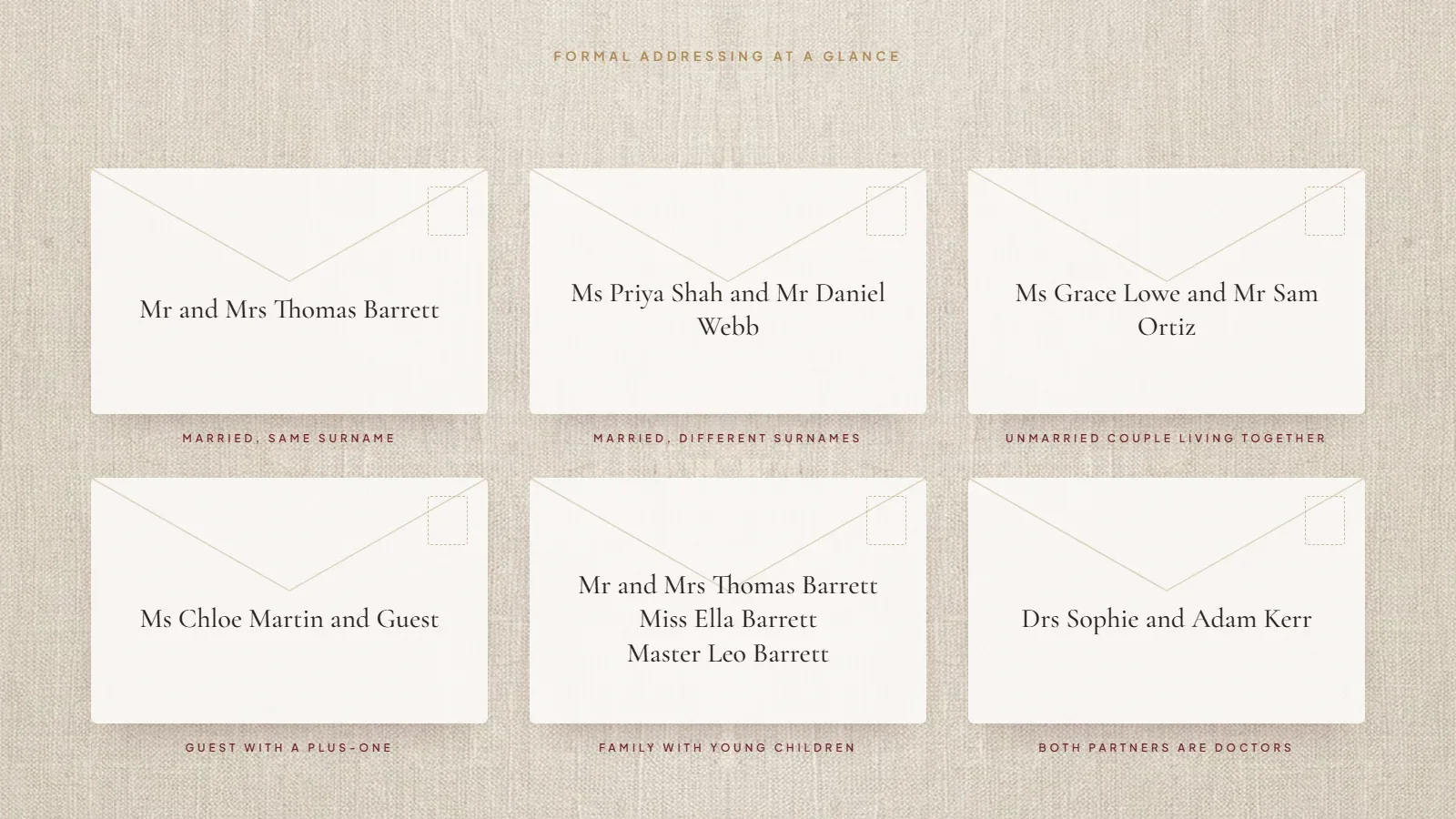
| Married couple, same surname | Mr and Mrs Thomas Barrett | Laura and Tom Barrett |
| Married couple, different surnames | Ms Priya Shah and Mr Daniel Webb | Priya Shah and Daniel Webb |
| Married couple, one hyphenated surname | Mrs Clare Hollis-Ward and Mr Ian Ward | Clare Hollis-Ward and Ian Ward |
| Unmarried couple living together | Ms Grace Lowe and Mr Sam Ortiz | Grace Lowe and Sam Ortiz |
| Same-sex married couple | Mr Ben Hughes and Mr Daniel Hughes | Ben and Daniel Hughes |
| Non-binary guest | Mx Alex Morgan | Alex Morgan |
| Single woman | Ms Hannah Wells (or Miss, if she prefers) | Hannah Wells |
| Single man | Mr Oliver Grant | Oliver Grant |
| Guest with an unnamed plus-one | Ms Chloe Martin and Guest | Chloe Martin and guest |
| Guest with a named partner | Mr Jack Dunn and Ms Isla Fraser | Jack Dunn and Isla Fraser |
| Family with young children | Mr and Mrs Thomas Barrett / Miss Ella Barrett / Master Leo Barrett | Laura, Tom, Ella and Leo Barrett |
| Adult child living at home | Miss Ruby Barrett (her own invitation) | Ruby Barrett |
| One partner is a doctor | Dr Sophie Kerr and Mr Adam Kerr | Sophie and Adam Kerr |
| Both partners are doctors | Drs Sophie and Adam Kerr | Sophie and Adam Kerr |
| Widowed guest | Mrs Thomas Barrett, or Mrs Margaret Barrett | Margaret Barrett |
| Military officer and spouse | Major and Mrs Edward Lane | Edward and Kate Lane |
| Member of the clergy and spouse | The Reverend Sarah Ellis and Mr Tom Ellis | Sarah and Tom Ellis |
These examples are illustrative, not compulsory. In the US, add a full stop after each abbreviated title: Mr., Mrs., Ms., Dr., Mx. and Drs. Whatever a guest calls themselves always outranks the table.
How to Address Wedding Invitations to Married Couples
Married couples with the same last name
The most traditional form uses the husband’s full name: “Mr and Mrs Thomas Barrett”. Plenty of guests still like it, particularly older relatives, but many women now find it dated. A modern formal version names both people.
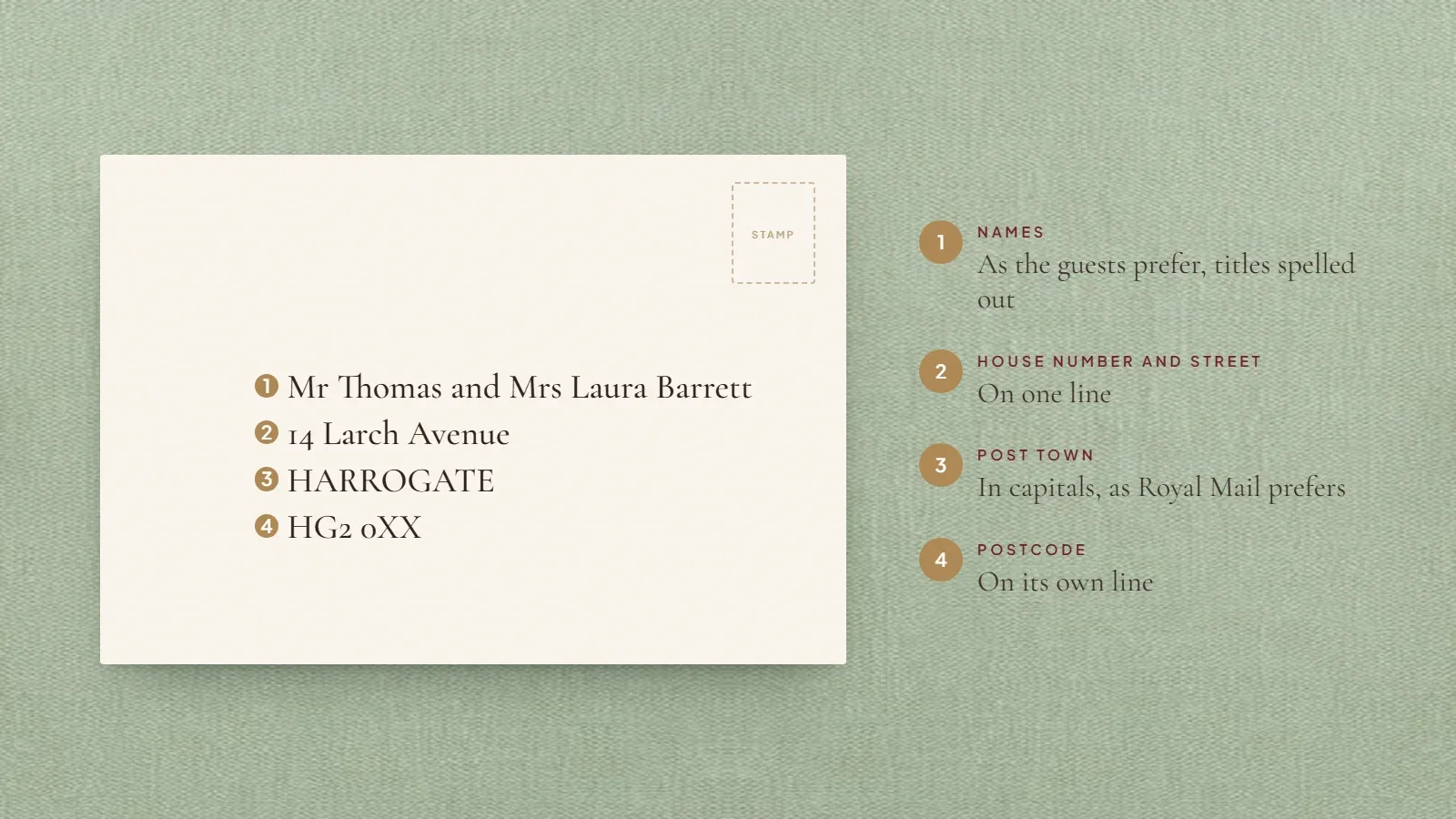
Mr Thomas and Mrs Laura Barrett 14 Larch Avenue HARROGATE HG2 0XX
Mr. and Mrs. Thomas Barrett 214 Linden Street Hartford, Connecticut 06105
Royal Mail prefers the post town in capitals and the postcode on its own line. In the US, formal etiquette spells out the state, although the postal service is just as happy with “CT”.
Married couples with different last names
Write both full names on one line, joined by “and”. Traditionally the person you know better goes first; if you know them equally, go alphabetically by surname. “Ms Priya Shah and Mr Daniel Webb”, or in the US, “Ms. Priya Shah and Mr. Daniel Webb”. For a hyphenated name, write it exactly as the guest does, even if their spouse does not share it.
Gender-neutral titles
Mx (pronounced “mix”) is the widely accepted gender-neutral title in the UK and increasingly in the US. Use it only for guests who use it themselves; otherwise, drop titles for everyone in the household so nobody stands out.
Mx Alex Morgan and Ms Jess Morgan Flat 2, 9 Chapel Row CAMBRIDGE CB1 0XX
Same-sex couples
The same rules apply: one line for a married couple, both full names. “Mr Ben Hughes and Mr Daniel Hughes”, “Mrs Amy Clarke and Mrs Leah Clarke”, or simply “Ben and Daniel Hughes”. Order by closeness or alphabetically by first name. Avoid “Mr and Mr Hughes” unless you know they like it.
How to Address Wedding Invitations to Unmarried Couples
Couples who live together receive one invitation, with both full names. Etiquette books differ on whether they go on one line or two; both are correct, so choose one and use it for every couple in the same situation.
Ms Grace Lowe Mr Sam Ortiz 37 Kingsley Road LONDON SE15 0XX
Couples who live apart traditionally receive separate invitations at each address. If that feels excessive for long-term partners, send one invitation to the person you know better with both names on it, such as “Mr Jack Dunn and Ms Isla Fraser”. Write the partner’s name rather than “and Guest” whenever you know it: it is warmer, and it makes place cards easy.
How to Address Wedding Invitations to Families
Parents and children under 18
List the parents first, then the children by age, oldest first. Girls are traditionally “Miss” and young boys “Master”, though most couples now use first names for children. In the UK, children’s names are often added to the handwritten line on the card rather than the envelope.
Mr. and Mrs. James Porter Miss Charlotte Porter Master Henry Porter 88 Willow Brook Lane Austin, Texas 78704
Kate, James, Charlotte and Henry Porter
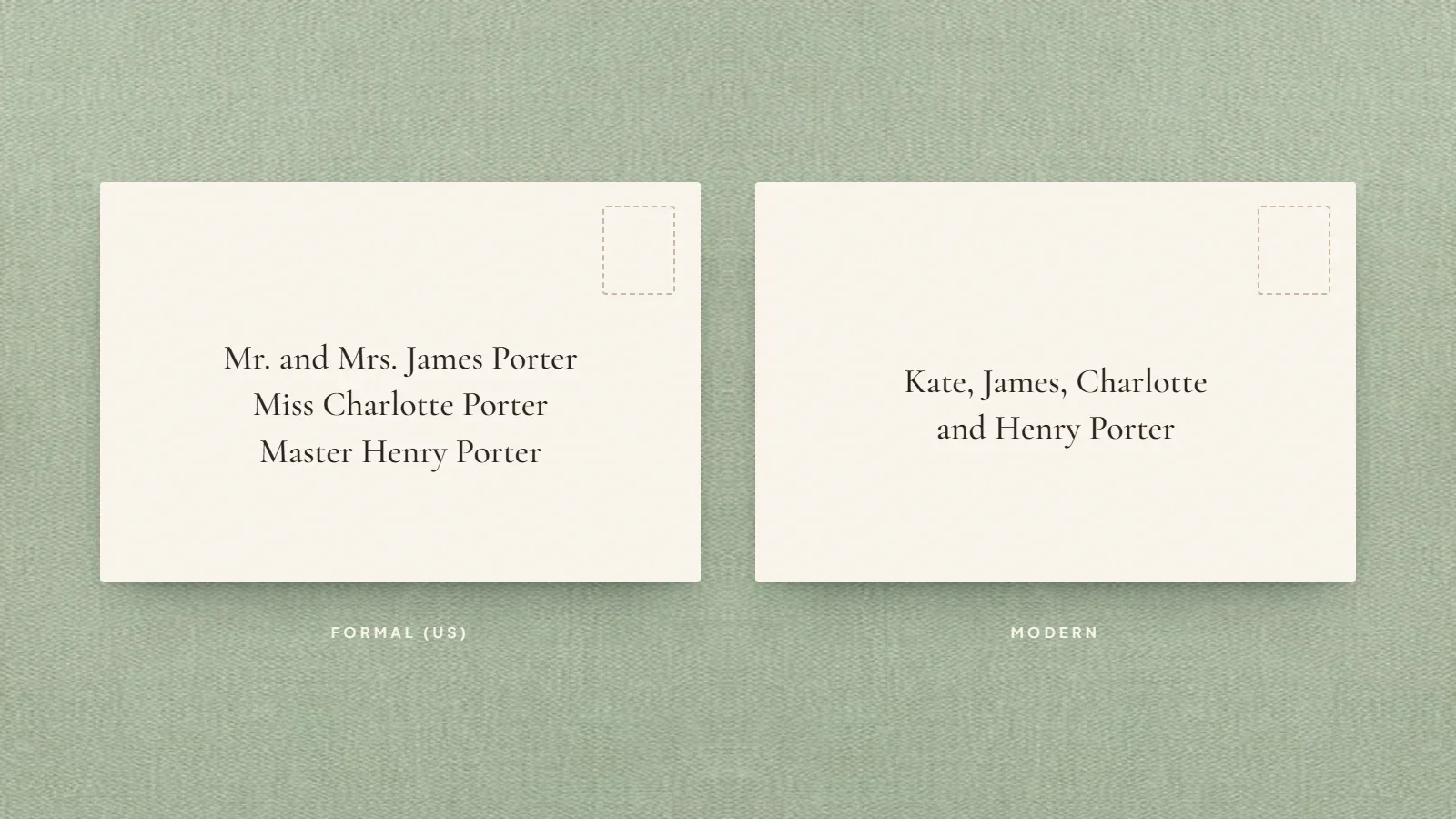
“The Porter Family” is quick, but it is ambiguous: does it include the 19-year-old, or the grandmother who lives with them? Use it only for a household where you genuinely mean everyone, and confirm the number of seats on the RSVP.
Adult children
Children aged 18 or over traditionally receive their own invitation, even if they still live at home. It treats them as adults and lets you offer a plus-one if you wish.
Families with different surnames
Name each person in full when surnames differ, as many blended families do: “Ms Rebecca Holt and Mr Mark Doyle, Lily Doyle and Finn Holt”. It is longer than “The Holt-Doyle Family”, but nobody will be left wondering whether they are included.
How to Address Wedding Invitations to Single Guests
A single guest’s envelope carries their name and title alone: “Ms Hannah Wells” or “Mr Oliver Grant”, or “Mx Alex Morgan” for a non-binary guest. If they have a plus-one, add “and Guest” on the same line, or the partner’s name if you know it. Leaving “and Guest” off means the invitation is for them alone. Our plus-one wedding invitation wording guide covers how to word the offer, and how to say no politely.
How to Address Wedding Invitations to Doctors and Professionals
- Medical doctors: “Dr Sophie Kerr” in the UK, “Dr. Sophie Kerr” in the US. On very formal US invitations, “Doctor” is spelled out.
- Surgeons in the UK: many traditionally use Mr, Mrs, Miss or Ms rather than Dr. Follow how they sign their own name.
- Academic doctors (PhD): use Dr if they use it socially; many keep it for work. Ask if you are not sure.
- Two doctors with the same surname: “Drs Sophie and Adam Kerr”, or “The Doctors Kerr” on an American inner envelope.
- Two doctors with different surnames: “Dr Sophie Kerr and Dr Adam Patel”.
- Clergy: the title comes first, whoever holds it: “The Reverend Sarah Ellis and Mr Tom Ellis”.
- Military officers: rank before the name. “Major and Mrs Edward Lane” in the UK; in the US, “Major Edward Lane, US Army, and Mrs. Lane”. The higher-ranking partner goes first.
- Judges in the US: “The Honorable Ruth Carter” on the outer envelope, “Judge Carter” inside.
- Knights in the UK: “Sir James and Lady Hall”.
Leave out degrees and professional letters after a name; they belong on work correspondence, not a wedding envelope. And a title is not compulsory for a relaxed wedding: first names for everyone are perfectly polite, provided you do it for every guest.
How to Address Wedding Invitations Without Inner Envelopes
With a single envelope, the outer address has to do everything. Write every invited person on it, including children. If space runs short, write the adults on the envelope and the children’s names on the card, as UK couples traditionally do.
Make plus-one instructions impossible to misread. “Ms Chloe Martin and Guest” on the envelope, plus a line on the reply card or RSVP page such as “We have reserved two seats in your honour”, removes any doubt. If the wedding is adults-only, say so on the invitation; the envelope alone will not stop guests bringing children. Our wedding invitation etiquette guide covers how to word that kindly.
How to Address Digital Wedding Invitations
Digital invitations have no envelope, so the greeting in your message does the same job. The courtesies are identical: name everyone invited, use the names guests prefer, and send to each household separately.
Greeting guests in an email
Match the greeting to how you know them. “Dear Mr and Mrs Barrett” suits a formal note to your parents’ friends; “Dear Laura and Tom” suits almost everyone else.
Subject: Wedding invitation · Charlotte & Edward · Saturday 5 June 2027 Dear Mr and Mrs Barrett, Charlotte and I would be delighted if you could join us for our wedding at Cliveden on Saturday 5 June 2027. Your invitation, with all the details and RSVP: [your link] With warmest wishes, Edward Lyle
Addressing guests in WhatsApp invitations
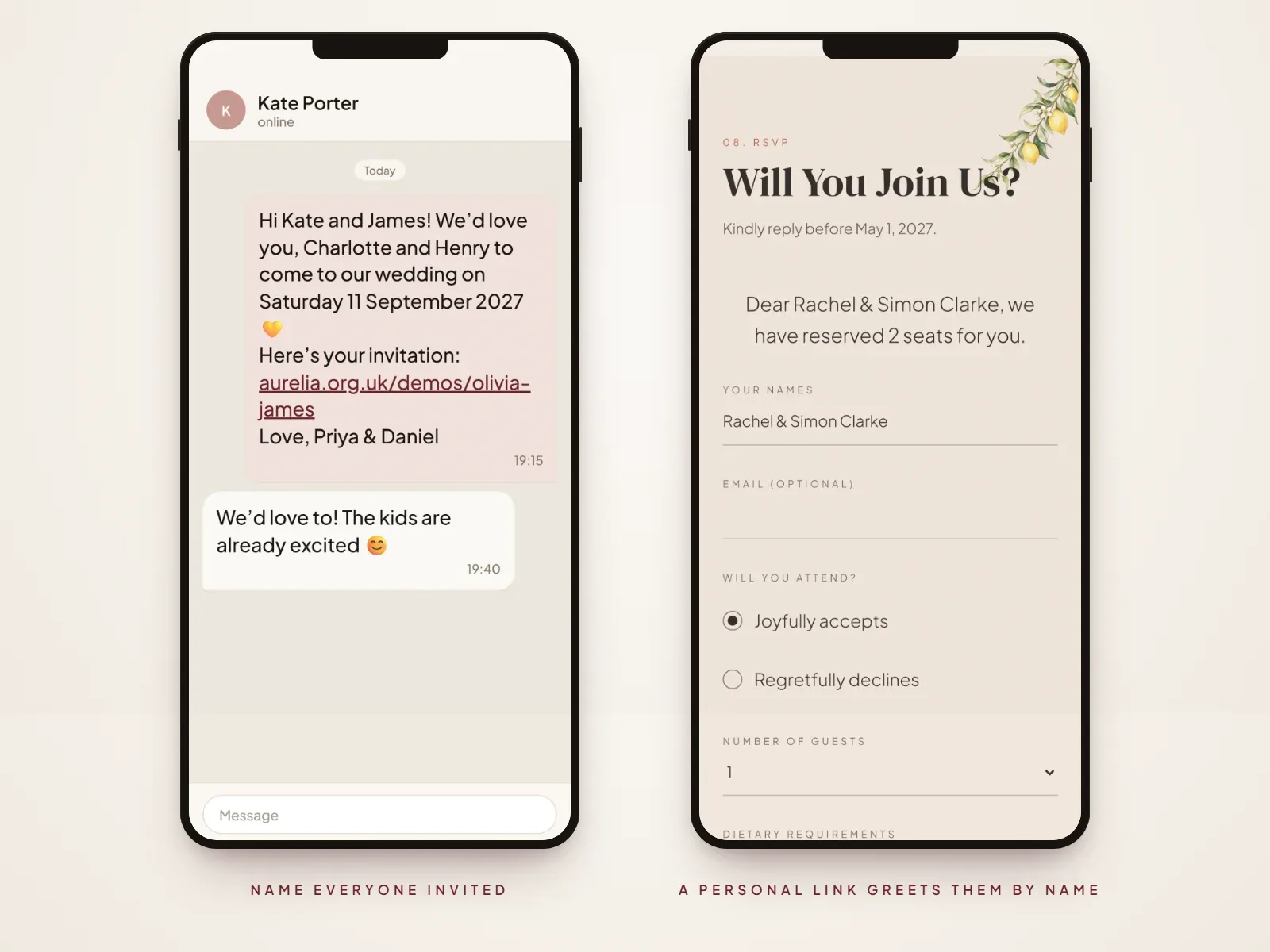
WhatsApp is personal, so use first names and name every person you are inviting, including children.
Hi Kate and James! We’d love you, Charlotte and Henry to come to our wedding on Saturday 11 September 2027 💛 Here’s your invitation: [your link] Love, Priya & Daniel
Sharing a wedding website link politely
Never send a bare link. Put a sentence or two in your own words above it, and say what the link is so cautious guests know it is safe to open.
Clarifying plus-ones and children
Spell it out in the message, because there is no envelope to do it for you.
Hi Chloe, we’d love you to come to our wedding, and you’re very welcome to bring a guest. All the details are here: [your link]
Dear Grace and Sam, we would love you both to join us. We’re keeping the day adults-only, so we hope you can enjoy a night off! Your invitation: [your link]
Personalising the message
With Aurelia, you share one invitation design, but each guest can have a personal link that greets them by name on the reply form and sets how many seats they have. Import your guest list from a spreadsheet, write each name exactly as you would on an envelope, and send each link with the WhatsApp or copy-link button beside that guest in your dashboard. The guest sees “Dear Laura and Tom”, and nobody can add an extra seat by mistake.
If you would rather skip envelopes, stamps and address-hunting altogether, send your wedding invitations beautifully, without the postage.
Common Wedding Invitation Addressing Mistakes
- Inconsistent names: “Mr and Mrs Barrett” on one envelope and “Laura & Tom” on their friends’ envelope looks careless. Choose one level of formality per group.
- Assuming surnames or titles: not every married woman changed her name, and not every Dr is a medical one. Check your list with family before printing.
- Ambiguous plus-ones: “Hannah Wells & Co.” or “Hannah and family” invites arguments. Write “and Guest” or the partner’s name.
- Missing flat or apartment numbers: an invitation to “21 Elgin Crescent” without “Flat 4” may sit in a shared hallway for weeks.
- Leaving out invited family members: a teenager left off the envelope reasonably assumes they are not invited.
- Outdated details: guests move, marry and divorce. Ask for addresses rather than copying last year’s Christmas list.
Frequently Asked Questions
- Do you write Mr and Mrs on wedding invitations?
- On formal invitations, yes: “Mr and Mrs Thomas Barrett” in the UK, or “Mr. and Mrs. Thomas Barrett” in the US. For a relaxed wedding, first names such as “Laura and Tom Barrett” are just as polite.
- Which name goes first on a wedding invitation envelope?
- For a couple with different surnames, the person you know better goes first; if you know both equally, use alphabetical order. For military couples or two professionals, the higher rank or title traditionally goes first.
- How do you address a wedding invitation to an unmarried couple?
- If they live together, send one invitation with both full names, either on one line joined by “and” or on two lines. If they live apart, send separate invitations, or one to the person you know better with both names on it.
- How do you address a family with children?
- Write the parents first, then the children in order of age. Formally, girls are “Miss” and boys “Master”; most couples now use first names. Children aged 18 or over traditionally get their own invitation.
- Do digital wedding invitations need formal greetings?
- Only if the wedding is formal or you would address that guest formally in person. A warm “Dear Laura and Tom” is right for most guests. What matters more is naming everyone invited.
- Can you address wedding invitations without titles?
- Yes. Leaving out titles is now common and perfectly polite, especially for modern weddings. Just do it for every guest, so nobody seems singled out.
For the wording inside the invitation, see our wedding invitation wording guide, and if you are still at the planning stage, start with a digital save the date. When the guest list is ready, send your wedding invitations beautifully, without the postage.
Part of our etiquette guides. Start with Wedding Invitation Etiquette: The Complete Modern Guide, or see every guide on this topic.